I believe that these three words can have more weight than “I love you”. For instance, I love people in general and I love my cat. Based on a previous definition I gave of love (Love…Anyone?), it is impersonal but also delightful.
Trust, on the other hand, is very personal. Merriam-Webster’s Dictionary defines trust as “assured reliance on the character, ability, strength, or truth of someone or something.” Sounds quite personal to me. Trust can be developed, or it can already be established, depending on the situation.
Either way, it can be lost.
Someone can love another person but feel he or she cannot trust that person. Trust is a delicate gift that requires vulnerability.
In my profession of healing and transformation, the people I serve must trust me. They trust me to keep their best interests in mind. They trust me to be knowledgeable and experienced in the services I provide. They trust me to honor their sacredness and respect their privacy. Most of my clients do not say the three words out loud, but their actions and willingness in the sessions speak to this truth.
Ultimately, when you trust someone, you are allowing yourself to be in the vulnerable space of innocence and complete surrender. One of the most detrimental things that can happen in this line of work is for the healer to violate or break the trust of their client.
I could go further into this issue, but I will focus more on things you can do (as a client) to see if someone is trustworthy. These suggestions are geared towards the healing profession; however they can also be applied to personal interactions as well:
Do your research (Is the person qualified? What do others say about their experiences with the person? What skills/characteristics are you looking for?)
Listen to your gut (Intuition supersedes intellect; Do you feel safe? Do you feel heard? Do you feel respected?)
Ask questions (Get clarification on whatever you need to.)
Express yourself (Make your requests and needs known. Then refer back to number 2.)
In a society that promotes selfishness and self-centered gains, it is important for those of us in the healing profession to be selfless and genuine about providing the service the client needs.
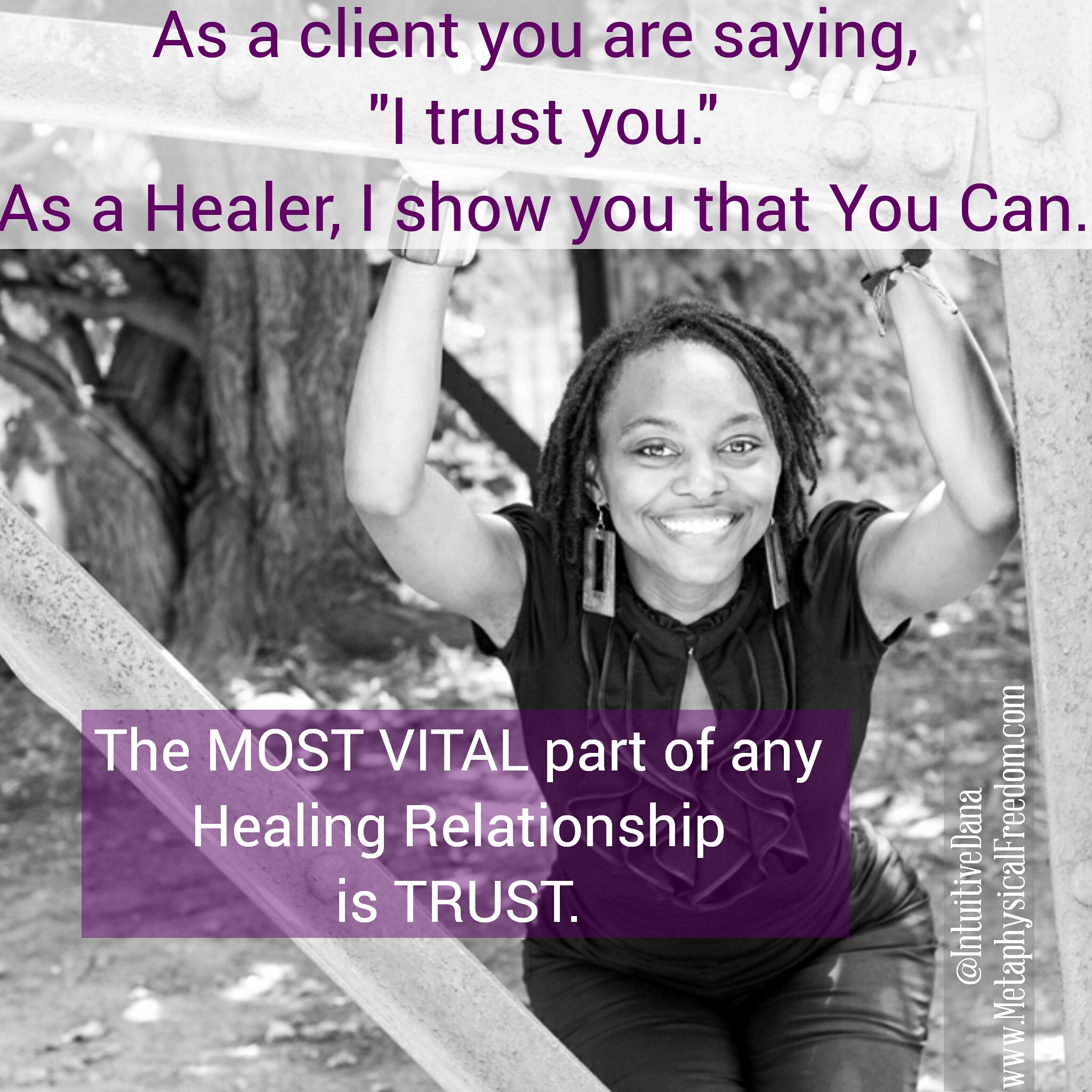
The MOST VITAL part of any healing relationship is TRUST.
As a psychotherapist, one of the last things that I want to hear is that one of my clients has killed or taken the life of himself or herself (or someone else). It is not because of a personal feeling of failure, but because of a sense that somewhere in the process, my client has lost hope. As therapists, one of our most powerful intentions is to instill hope. It is not a starry wish, but a sense of purpose and encouragement.
When I was in graduate school, I was drawn to the more intense subjects such as traumatology, addiction, and crisis stabilization work. I loved them! I remember sitting in a crisis intervention class and hearing my professor clearly state, “In all your years as a therapist, all of you will lose at least one client to suicide. Be prepared for it. It will happen. Oh, and those of you who are working with trauma and addiction, you can definitely expect it to happen.” He spoke those words with a matter-of-factness that revealed long years of personal experience. I did not want to believe him, but I also knew that there was some underlying realness to what he said.
Even with this warning, I pressed on and continued down the path to become a licensed therapist. I did not and could not lose hope in the long-lasting positive impact of the work we do. I believed that following my passion and helping others to see their inner light was worth much more than living in fear of those who might not see it.
For a little while, I even worked for a crisis hotline. Some of the callers were blatantly at the point where they had chosen to end their lives. I encouraged some to rethink their situations and to see that life might actually be worth living. However for some, I do not know if they did or did not take their lives…the calls simply just ended.
Ironically enough, I didn’t feel disappointment, but gratitude. How might one be grateful for such a thing? I fully understood that the conversations that I had with the callers may have been their last conversations ever. I was at least thankful to talk to them in the present moment and be some type of positive, loving voice before they departed (or decided to live).
And here I am… 8 years and 2 client suicides later.
I will not get into too much detail about the 2 client suicides; however I will say that both were very sobering experiences for me. I re-learned that suicide shows up in many forms.
A spiritual reality about suicide came to me as well:
A person’s exit from this world is not an accident. The way we transition may serve a greater purpose, just like the way we live. It is true that sometimes a person’s life purpose may not be easily understood or clear. But be aware that every life, no matter how short, undoubtedly leaves a precious legacy on this planet.
Every day that I choose to continue working as a psychotherapist and addiction counselor, the possibility of losing a client to suicide, overdose, or something exists. Yet, if a little piece of hope surfaces, then I believe there is a chance that the person will see tomorrow. I Know the power of hope. It starts as a glimmer, and then it becomes a belief. Belief is when the person sees more light and direction. Then a belief transforms into Knowing. Knowing (in this context) is when the person is aware that Life Is.
If you or someone you love is struggling with depression, suicidal thoughts, or self-harm, please Know that There is Hope.
For nationwide support in the United States you can contact: 9-8-8.
“Do what you can, where you are, with what you have, and never be satisfied.” -Les Brown
Many people express that they don’t pursue a dream or a goal because they want the conditions to be a certain way, or they want things to be perfect. In reality, the conditions won’t change until the person decides to get into motion and to continue to stay in action.
I can admit, in the past, I have been guilty of putting off a goal or a desire due to circumstances. In the past, I have told myself that I had to wait until the situation was perfect or certain pieces were in place. True, there were times when it was necessary to wait on the other pieces of the puzzle, but it was never time to stop doing things towards my goals and desires.
The Law of Attraction expresses that whatever we put energy and attention towards is what we draw unto us. This universal law is simple, and can be actively applied to manifest one’s desires.
However, here is something to consider: If someone told you that your present situation and surroundings are the result of your past thoughts and actions, would you be bothered, or would you be willing to take responsibility for yourself?
One of the hardest things that I had to admit to myself was that I am responsible for myself and my progress.You are responsible for yours too.
Of course, this does not mean that you won’t face challenges and obstacles along the way, but it does mean that you can choose the course of action you take once they arise. Ideally, when a challenge arises, one of the best things you can do is mindfully look within and look at key areas connected to this challenge.
Four key areas to examine when facing challenges: 1) Thoughts–What do I really think about this situation? OR What are my exact thoughts? 2) Emotions–How do I really feel about this situation? 3) Underlying Messages–What is this situation helping me to learn? 4) Positive Behaviors–What am I able to do right now that supports a positive outcome?
Examining these things gives you an opportunity to shift a possibly negative perspective into an empowered one. This empowered perspective is one where you recognize that you have choice, and you can make a decision based on the understanding that you are always learning and evolving. Depending on the situation, the choice itself can range anywhere from sweet surrender to engaging in more focus-driven actions.
It is your choice.
Remember: Every action (or lack thereof) always results in some type of outcome.
Think about your life goals and how far you have come towards meeting these goals. Consider the one most important thing that affects the realization of your goals: YOU
What are you focusing on daily? What are you doing daily? Are your thoughts and actions moving you towards or away from your goals? You always have choice.
Right now, you have made a choice to read this post. In reading this, my hope is that you are gaining some insight or awareness about yourself and how powerful you really are.
There is one thing that I would change about the wording Les Brown used in the quote above.
I would say:
“Do what you can, where you are, with what you have, AND continue to expand.”
There is power in your decision to stay in motion.
When your heart speaks to you, do you listen? OR Do you talk yourself out of what is being said to you?
There comes a moment when we know without a doubt that we are being called to do more with our talents, our gifts, and essentially our lives.
Depending on where you are in your journey, some people might call it a mid-life crisis. In some spiritual communities, this process is referred to as Divine Discontent. I like to use this phrase because it is more than just a developmental stage; it is the Universe’s way of getting your attention and growing you into someone even better than you were before.
From personal experiences, and working extensively with several clients, I recognized that this process typically happens in stages.
Here is my summary of the stages related to Divine Discontent:
Stage 1: Misalignment= This is when you begin to feel out of sync with what is going on in your life. The things that you normally do might start to feel monotonous and boring. You might start to feel fleeting senses of disinterest or displeasure for these things. (Not to be mistaken for depression symptoms.)
Stage 2: Denial=The awareness of your misalignment increases, but instead of looking further into the reason behind it, you go against what you are feeling and try to continue in your monotony. You basically talk yourself out of whatever it is that you are feeling…or at least you try… which leads to the next stage.
Stage 3: Detachment = This is when you still are not quite ready to “dig deep” and give anything up or make major changes, so you start to distance yourself emotionally from the things that are causing the discontent. Unfortunately, this state of discontent may also spill over into other things in your life. People might notice and comment on your shift in mood and your distant presence. You can’t hide it anymore.
Stage 4: Epiphany/Climax/Aha Moment =This is when Shift Happens. Your discontent pushes you to the edge of introspection. You look inward, and question what is at the core of your feelings. You realize that you need to make changes, whether small, medium, or major ones. You decide that you are willing to make these changes.
Stage 5: Pursuit = You take action and make the necessary changes so that your discontent decreases. You actively seek guidance, whether it be inward, from mentors, or both. You change your direction and move towards your new goal.
Stage 6: Alignment= You feel more alive and the things you are doing or engaging in feel right. You no longer have that unpleasant sense of monotony or boredom. You are in motion, and it seems like everything and everyone around you are propelling you so that you stay in motion.
Stage 7: Realization= You reach that point of bliss where you know that you are doing what you are meant to do. You have moments where you reflect upon where you were before this stage, and you are grateful that you made the changes. You realize that everything was already worked out for your benefit, and all you had to do was take the first step.
Consider what things (or people) in your life that you feel discontent with. How long have you allowed this feeling to linger?
This life we live is precious and priceless…similar to the beauty of these flowers.
There is one significant mystery about Life: Our amount of “time” in the physical world varies from person to person.Time is one of our most precious and irreplaceable treasures. Not the time on clock, but the Life you Live. HOW we spend our time matters. WHO we spend our time with matters. Essentially, we are sharing our Life when we give of our time.
Today I am remembering the life of a good friend whose time on Earth was less than mine: Kenny Reeves, who passed away from leukemia on July 24, 2007. I appreciate the smiles, laughter, and laid-back fun we all had with Kenny, yet at that time, I questioned why someone who was younger than me would also leave the physical realm before I did.
Today, I am also thinking about the people and things in my life that I give time to. I have purposely strayed away from some traditional 9-5 jobs because I value my time and the way that I use it. It can be challenging to spend a lot of your time doing something when you would rather be doing something else with that time. There have been jobs that I absolutely LOVED, which I have given more than the 40 hours a week, yet it was easy to do so.
It is empowering to be consciously aware and to live in the moment. Here is an example of my experience with acting in the moment.
In one of my graduate school courses, my professor proposed a challenge to us, related to the present moment. He dared us to express whatever message we wanted to share with someone who was not in the class, as we were sitting in the middle of class. In a very matter-of-fact voice the professor said, “When you walk out this door after class, you are not guaranteed to return. Hell, you are not guaranteed to finish this class and leave out of here! You havethismoment. What would you do? What would you say to someone that you love or care about right now? I dare you to do it.”
I felt the weight of his challenge like a rock was in my stomach. I thought of several people to text or call, but I felt like I had to make a quick decision. (He was counting down). I took out my cell phone and dialed the first number that came to mind. I looked around and saw that several of my classmates were taking out their phones too. A few people got up and left out of class. The professor smiled, and he took out his phone. The room fell silent as everyone was texting or awaiting to hear from the person on the other line.
I began to think about what was happening. What really bothered me about the challenge was that a lot of what he said had validity to it. It made me think of what it must have been like for people when 9/11 happened, or school shootings, or even hostage situations. (Oddly enough, the class was a crisis intervention course.)
My thoughts were interrupted by hearing a ring and then airy silence…
My mother answered. I heard her gentle voice and immediately said to her, “Mom, I just want you to know that I love you.” My voice was shaky for some reason, but I kept talking. “I am in class, and we were told that if all we had was right now, what would we do or who would we contact. I chose to contact you. I am okay, but I just wanted you to know that I love you.” She sounded a little worried, but she graciously said, “I love you too honey.” It was comforting. After we hung up, I texted several of my friends to let them know how much they mean to me. I could hear chatter all over the classroom, and the prominent message I heard was, “I love you.”
This awakened my consciousness again.
At that time, I was so caught up in my own routine as a graduate student that I had drifted away from living mindfully. I appreciate my professor for doing this exercise because I never forgot that experience, and how I felt in that moment. I allowed myself to think about what matters to me the most and evaluated how I acknowledged those things.
I hope this makes you think about what you are doing with your time on this planet.
We need not wait until a tragedy happens in order to appreciate Life. We need not wait until a death occurs before we join together to celebrate Life.
LIFE Is Right NOW.
Who or what do you need to give time to today? Sit down, take a moment, and make time for it.
I love writing, and maybe you do as well. My most consistent writing practice began in my early childhood. I had a diary. Oh, the juicy, secretive world of diaries with their special locks and “keep out!” signs. Then I graduated to journals. I had several black and white composition books filled with some of my most intimate moments, fears, joys, and requests to God. I journaled almost everyday.
Recently, during the process of packing, I stumbled upon my journals from high school and college. I sat down for a moment and carefully read over my entries. I wrote passionately about my woes related to school issues, family, friendships, and relationships gone awry.
There was a pattern that took place in my writing: 1. I started out writing about the day (Ex: It was a rough day); 2. Then, I wrote extensively about the suffering or strife that I perceived I was experiencing (exaggerating most of it, by the way); 3. Lastly, as if in response to my discouragement, I wrote wise words of encouragement that were well beyond my years of experience and knowledge.
(Ex: I know that this is a situation where I am meant to learn about…)
I read through several of these journals, and was fascinated by something within them that I hadn’t noticed before.
You see, when I read more closely, I realized that I was also prophesying to myself in every entry.
At the time that I wrote the entries, I did not realize that they were more than words of encouragement, but actual prophecy. I didn’t know they were true until I reflected on the entries recently and recognized that most of the things had occurred!
But… Where did those prophetic words come from?
I went into meditation about this question, and here is some of what was expressed to me. Spirit reminded me that I am always taken care of and supported by unseen forces. It was brought to my attention that when I wrote my journal entries, they were a way for me to connect with My Creator and seek guidance. It was a form of prayer.
The most beautiful message I received was this reminder: “I already knew what you needed. I already saw everything you were going to request. I Am in You. Be in a place to receive those things.”
This makes me think of a biblical text that states, “Before I formed you in the womb I knew you…”
Take the time to think of all the things that you have requested of Spirit. What would it mean for you to know that your requests are already known?
Better yet, what if there is already an answer?
There Is.Affirm for yourself today: Everything is already in order, and the solution is clear.
Love is more than just a feeling. Love Is a way of Living.
Modern culture frequently displays love as a sense of feel-good, fantasy, and endless romantic awe. Yet, these types of examples are temporary expressions of a bigger, more infinite concept. Think about this:When did you first learn about love? Who told you what it means? What thoughts, feelings, and experiences do you associate with love?
Many years ago, I had the misconception that love = suffering. I thought that loving someone always meant to sacrifice, to put the other first, and to stretch myself in order to make the other person happy. I did this not only in romantic relationships, but also in relationships that I considered to be very important to me.
However, one common and major thing kept happening…I was left feeling betrayed, used, and alone.
This sent me on a journey to re-evaluate my understanding of love. I reflected upon my experiences, looked at the spiritual aspect, read books, and then went out and asked questions from my elders.
One of my favorite graduate professors was in his late 80s. He shared this definition of love: “To take delight in the spiritual development of another”. When I first heard it, I felt a squiggly warmth and childlike curiosity. The definition seemed so plain, but when you look at it more closely, it actually involves several layers.
To take delight in another person’s spiritual development also includes the ability to let go of expectation, to eliminate judgment, and to release the need to be right. This way of loving causes you to accept a person as he or she is, because you are aware that spiritual growth is always taking place. To love in this way is to understand that the person is doing the best that he or she can, based upon his or her own circumstances (thoughts, beliefs, actions, feelings)…even if you don’t like it.
Don’t get me wrong. If someone is treating you in a way that is condescending, harmful, or life-threatening, and using “love” as the reason, I am not referring to this situation. This is not love. This is manipulation and abuse.
The love that I am referring to is made up of thoughtfulness, positive regard, and a healthy detachment. Yes, detachment. I’m sure you’ve heard someone say, “If you love someone, you will let ‘em go.”
Loving someone on the spirit level creates a greater sense of freedom for you and that person.
In various Biblical and spiritual texts, it is expressed that “God is Love” (Feel free to put The Universe, Creator, Allah, etc)…and “This Love is unconditional.”
Other texts also express that “Love casts out all fear.” Most of us have attached ourselves to others in unhealthy ways, saying it is love, when it is actually fear. Let go of the fear.
Look and see that the person is on his or her spiritual journey, and smile. Your supportive presence (even if at a distance) is more valuable than hovering around negatively out of your own worry.
Most importantly, see yourself this way. Be there for yourself as you go through your spiritual development. Remember, Real Love is unconditional anyway.
Take delight in your own journey as you Evolve in Love.
Think about this: What would happen if another person really knew you and was aware of all your “faults”?
Would you fear that this person would take advantage of you? Would you worry that the person may embarrass you? Would you be concerned that this person may have some type of power over you?
Due to all of these fears, would you start to lie in order to feel as if you have the “upper hand”?
Those are a lot of questions to consider.
Now, think carefully about this next question: What would really happen if this person… wholeheartedly accepted you as you are?
As humans, we often lose transparency due to distraction from our egos. You probably have heard of the term “ego” in psychology, developmental courses, or some forms of spirituality. In metaphysics, our egos can briefly be defined as the part of our humanness that correlates with fear, survival, selfishness, judgment, comparison, competition, and separateness.
Ego is not necessarily a negative part of our human experience; however the nature of it can contribute to internal and external conflicts as a person evolves spiritually.
The further along I have traveled on my spiritual journey, the more easily I notice when my ego appears. For example, I used to be an extreme perfectionist (possibly with traces of OCD) who felt that all areas of my life had to be a certain way. Perfectionism has its place, but it is a problem when it causes high levels of distress. I used to have very high expectations of myself and others, which only led to judgment and self-criticism. At times, I even hid information about myself because I was worried that I would appear “imperfect”. After a while, hiding things while also being judgmental took up a lot of energy and mental attention. It became an act of sorts.
One day, I got into an intense argument with a long-term friend of 10 years. She told me very pertinent things about myself that were difficult for me to listen to because they were so truthful and challenged the perfect image that I had portrayed for so long.
I noticed how far removed I had become from the core of who I am. It stung really bad. Even in that moment, I went through some judgmental thoughts and feelings, but then I released them. It was humbling in the least.
I came to an understanding that I did not have to hide anymore. I did not have to pretend that everything was perfectly aligned exactly how I wanted them to be. I let it all go, and admitted that I had many flaws and was finding my way through them all.
Admitting this about myself was freeing! It changed my perspective, and gave me the opportunity to shift my focus onto things that had more depth and meaning in my life. It truly was refreshing and life-changing.
The next few weeks of the holiday season can be challenging for many people as they spend time with relatives, friends, colleagues, or alone. This is the time of year where stress levels are heightened, loneliness is common, and depression and incidents of suicide increase drastically. This does not have to be. Much of the distress and negative emotions around the holidays come from a belief that things “should be” a certain away. Imagine if every person chose to be transparent, removing his or her veils and masks. So much unnecessary pressure would be lifted. Maybe you are the person to start this transparency trend among those you encounter.
Let it all go. Kindly Be who you are.
The more open we are about who we are and how we feel assists us to create an atmosphere where we are accepted, AND where others are able to be who they are as well.
BE transparent.
It gives us all permission to blossom, expand, and share our inner beauty.








 Metaphysical Freedom