I believe that these three words can have more weight than “I love you”. For instance, I love people in general and I love my cat. Based on a previous definition I gave of love (Love…Anyone?), it is impersonal but also delightful.
Trust, on the other hand, is very personal. Merriam-Webster’s Dictionary defines trust as “assured reliance on the character, ability, strength, or truth of someone or something.” Sounds quite personal to me. Trust can be developed, or it can already be established, depending on the situation.
Either way, it can be lost.
Someone can love another person but feel he or she cannot trust that person. Trust is a delicate gift that requires vulnerability.
In my profession of healing and transformation, the people I serve must trust me. They trust me to keep their best interests in mind. They trust me to be knowledgeable and experienced in the services I provide. They trust me to honor their sacredness and respect their privacy. Most of my clients do not say the three words out loud, but their actions and willingness in the sessions speak to this truth.
Ultimately, when you trust someone, you are allowing yourself to be in the vulnerable space of innocence and complete surrender. One of the most detrimental things that can happen in this line of work is for the healer to violate or break the trust of their client.
I could go further into this issue, but I will focus more on things you can do (as a client) to see if someone is trustworthy. These suggestions are geared towards the healing profession; however they can also be applied to personal interactions as well:
Do your research (Is the person qualified? What do others say about their experiences with the person? What skills/characteristics are you looking for?)
Listen to your gut (Intuition supersedes intellect; Do you feel safe? Do you feel heard? Do you feel respected?)
Ask questions (Get clarification on whatever you need to.)
Express yourself (Make your requests and needs known. Then refer back to number 2.)
In a society that promotes selfishness and self-centered gains, it is important for those of us in the healing profession to be selfless and genuine about providing the service the client needs.
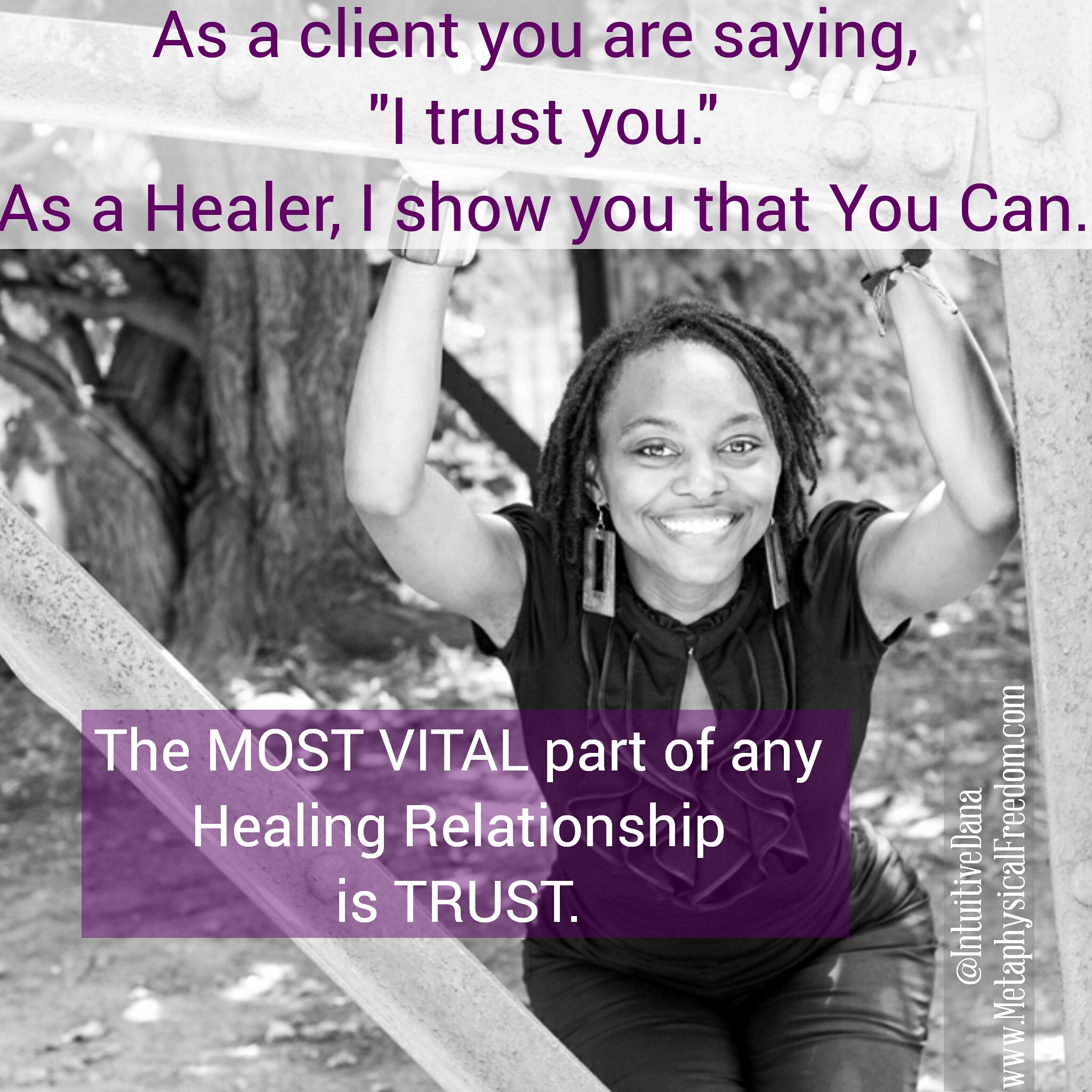
The MOST VITAL part of any healing relationship is TRUST.
Communication is the most important aspect to any and every relationship. There are different types of communication: Verbal, Nonverbal, and Paraverbal. PLUS, your Energetic Space/Aura/Overall Vibe communicates to others as well.
As a counselor, coach, and speaker, I am constantly communicating. However, I too have made the mistake of misjudging or making assumptions while communicating with others (especially in my personal life). These mistakes can be costly…leading to hurt feelings, lack of depth, and even loss of the relationships.
Maybe you just celebrated Valentine’s Day or an anniversary of some sort. Good job, you’re on the right track! Now, take a step back and see what your partner, friend, coworker, etc. is communicating to you. We can dive into the different types of communication here:
Nonverbal Communication– Most of our communication is nonverbal, meaning it is not what we say, but everything else. You may have heard this before, but let’s break this down into 2 main parts of nonverbal communication.
1. Proxemics-This is a fancy word that describes how physically close the person is to you, or you to the other person. Typically, the more physical closeness indicates more intimacy (emotional, mental, physical, etc.)
2. Kinesics-This is the fancy word to describe what most people would call body language. This includes movements, gestures, and facial expressions
Paraverbal Communication– Our vocal part of speech, which is our tone, volume, and how fast or slow we talk.
I am often a fast talker. Get me excited, and I talk faster. When I work with the people I serve, I am mindful of this, and I adjust. It makes a world of difference to have an even pace and a calm tone.
The way you say something matters!
Examples: “I didn’t say you were dumb.”– Say this with an even tone. Now try this one, “I didn’t say you were DUMB.” -Emphasize the last word. If you say this out loud, you can see that one of them is not meant to insult, whereas the other may cause conflict.
Of course, the other type of communication that I will address here is…
Verbal Communication: It is the use of words to relay a message or express an idea.
This is where many of us get caught up. In the emotional tornado of a moment, we might forget to pause and use mindful communication instead of emotionally driven words.
Let’s tie this in with conflict resolution. If there is conflict, I ask that you try these two things: Be willing to be wrong. Be willing to apologize.
Just an FYI: Conflict is a natural occurrence. The term has been blown up into great proportions meaning war, fighting, and death, but in reality, conflict is a simple, and organic process. Conflict arises because there are different perspectives within the same situation or regarding the same topic. It’s just that simple. We are individuals, so by default, there will be times when we do not have the same point of view. That is the core of conflict. It has been over-sensationalized through media. (That may be for another blog).
One of the keys to facing conflict and communicating effectively is to use Mindful Communication.
7 Core Guidelines for Mindful Communication: 1. LISTEN(And appear like you are listening)-As a counselor, I have gone through several hours of training to be more present with others as they share with me. We call it active listening. You don’t have to be a therapist to actively listen. The concept is simple: Make eye contact, don’t speak-unless you are affirming or encouraging the other to continue sharing, keep your body open, LISTEN FOR FEELINGS, and SEEK to UNDERSTAND what is being said.
Mindfulness Tip for #1–Detach emotionally. Keep in mind that the person you are listening to has something that he or she needs to express. Think to yourself, “Let me be here now. There is something that this person needs to say. I am listening.”
2. REFLECT or RESTATE WHAT YOUR HEARD-Do this BEFORE you share anything about your point of view.
Sometimes this step gets lost. Unfortunately, I have been guilty of this at times. For example, if your partner says, “I worked really hard to get those things that you wanted taken care of, and you don’t appreciate it.”
Be mindful and attentive to these things about your partner: Tone of voice, Energy level, Facial expressions, and mood. Notice…how close is the person to you physically?
Before you start saying your response, do this: A) Listen for the feeling being conveyed; B) Make eye contact (non-threatening); then C) Start with a statement acknowledging what you think you heard. “I hear you saying that you don’t feel appreciated for the hard work you did for me.”
3. CLARIFY: After you restate, check in with the person to make sure you got it right. “Did I hear you correctly?”Truth of the matter is that the person will let you know what’s up and if you got it right. This part is VALUABLE. Clarifying gives you the opportunity to understand the other person. At the very basic level, we communicate in order to express ourselves and to be understood. Understanding someone does not mean that you agree with what is said. It means that you are grasping the view of another’s perspective. Once you have gained clarity, then you can share your point of view from a more accurate perspective because you are identifying the real “issue.”
Mindfulness Tip for #3–Be patient and BREATHE. Take a moment to reflect on the person’s underlying message. Do not get swept away in emotions or the person’s emotional response. Ask, with the sole intention to get clear on what the person is saying.
4. OWN YOUR THOUGHTS AND FEELINGS, and share them: Use “I” statements instead of “You did this…”, “You make me…” etc.
Example: “When you say that I do not appreciate you, I feel hurt. I understand what you are feeling and what made you feel that way. I did not see it that way, and I was not aware of your disappointment. I have been working several extra hours each day and I feel more tired than usual.”
Mindfulness Tip for #4–Take a few calming, deep breaths and FOCUS ON YOUR HEART chakra. This is the space where you have affinity for others (and self). Speak from this place.
5. CHECK IN AGAIN AND SUMMARIZE: Allow the person to reflect back to you for clarity. (Make sure to use all the other skills mentioned above if needed.)
6. COMPROMISE/RESOLUTION: Remember the main reason for conflict? It is because different perspectives are related to the same situation. Often, there is a common ground or a space for compromise. During this step, request or offer a solution.
Example: “What would you like for me to do differently?”
Apply the skills from steps 1-5 again. Stay on the same topic! Focus only on 1 thing at this time.
Mindfulness tip for #6–BREATHE and remember that A SOLUTION IS ALREADY PRESENT
7. RE-ADDRESS the concern later on: This step might not be needed every time. However, if you and the other person aren’t able to address the issue well enough at the time it is presented, set a date to come back to it. A refreshed point of view about a conflict can make it easier to resolve.
Take these steps into consideration every time you are communicating with someone. This is the practice of mindful communication. It aids in developing healthy communication styles, preventing or resolving conflict, and developing a greater level of understanding.
Communicated with love, Dana D. Robinson (Intuitive Dana)
This life we live is precious and priceless…similar to the beauty of these flowers.
There is one significant mystery about Life: Our amount of “time” in the physical world varies from person to person.Time is one of our most precious and irreplaceable treasures. Not the time on clock, but the Life you Live. HOW we spend our time matters. WHO we spend our time with matters. Essentially, we are sharing our Life when we give of our time.
Today I am remembering the life of a good friend whose time on Earth was less than mine: Kenny Reeves, who passed away from leukemia on July 24, 2007. I appreciate the smiles, laughter, and laid-back fun we all had with Kenny, yet at that time, I questioned why someone who was younger than me would also leave the physical realm before I did.
Today, I am also thinking about the people and things in my life that I give time to. I have purposely strayed away from some traditional 9-5 jobs because I value my time and the way that I use it. It can be challenging to spend a lot of your time doing something when you would rather be doing something else with that time. There have been jobs that I absolutely LOVED, which I have given more than the 40 hours a week, yet it was easy to do so.
It is empowering to be consciously aware and to live in the moment. Here is an example of my experience with acting in the moment.
In one of my graduate school courses, my professor proposed a challenge to us, related to the present moment. He dared us to express whatever message we wanted to share with someone who was not in the class, as we were sitting in the middle of class. In a very matter-of-fact voice the professor said, “When you walk out this door after class, you are not guaranteed to return. Hell, you are not guaranteed to finish this class and leave out of here! You havethismoment. What would you do? What would you say to someone that you love or care about right now? I dare you to do it.”
I felt the weight of his challenge like a rock was in my stomach. I thought of several people to text or call, but I felt like I had to make a quick decision. (He was counting down). I took out my cell phone and dialed the first number that came to mind. I looked around and saw that several of my classmates were taking out their phones too. A few people got up and left out of class. The professor smiled, and he took out his phone. The room fell silent as everyone was texting or awaiting to hear from the person on the other line.
I began to think about what was happening. What really bothered me about the challenge was that a lot of what he said had validity to it. It made me think of what it must have been like for people when 9/11 happened, or school shootings, or even hostage situations. (Oddly enough, the class was a crisis intervention course.)
My thoughts were interrupted by hearing a ring and then airy silence…
My mother answered. I heard her gentle voice and immediately said to her, “Mom, I just want you to know that I love you.” My voice was shaky for some reason, but I kept talking. “I am in class, and we were told that if all we had was right now, what would we do or who would we contact. I chose to contact you. I am okay, but I just wanted you to know that I love you.” She sounded a little worried, but she graciously said, “I love you too honey.” It was comforting. After we hung up, I texted several of my friends to let them know how much they mean to me. I could hear chatter all over the classroom, and the prominent message I heard was, “I love you.”
This awakened my consciousness again.
At that time, I was so caught up in my own routine as a graduate student that I had drifted away from living mindfully. I appreciate my professor for doing this exercise because I never forgot that experience, and how I felt in that moment. I allowed myself to think about what matters to me the most and evaluated how I acknowledged those things.
I hope this makes you think about what you are doing with your time on this planet.
We need not wait until a tragedy happens in order to appreciate Life. We need not wait until a death occurs before we join together to celebrate Life.
LIFE Is Right NOW.
Who or what do you need to give time to today? Sit down, take a moment, and make time for it.
In March 2015, I traveled to Ghana, West Africa and stayed for a month.This was my first official flight overseas, so I was nervous. I was not sure what to expect on my way to Ghana. I flew solo, and was going to meet my host family at the final destination in Accra. I took a red-eye flight, but there was a brief layover in Amsterdam. When I made it to Amsterdam, I could already feel a difference in the air. There was a sense of movement and action that did not feel like mindless busyness.
My layover was only for a few hours, so I made my way to the next gate for the plane heading to Accra, Ghana. When I got to the gate, I immediately noticed that almost everyone was Black. The people’s beautiful dark skin had a supernatural glow. I KNEW I was among Africans. It was an exciting feeling. The second part of the flight was long and turbulent. When the plane landed in Accra that night, most of the passengers applauded in relief. Shuttle buses came to the plane to pick up the passengers and take us into the airport. It was raining and humid, but I was in Africa!!
The customs line was long, and I had to wait for over an hour to make it through. Many diverse people were in the line with me. I saw Chinese, Lebanese, Nigerian, Belgian, and Canadian visitors, just to name a few. I admit that I was surprised to see many “foreigners” coming to Ghana. Then it hit me…I realized that I may have had some subconscious stereotypes and misconceptions about Africa even though I consider myself to be a very open-minded and an independent thinker. Due to this realization, this first post of the series is going to address some of the stereotypes and myths that many people might have about Africa. Although I was only in Ghana, I think that a lot of this information is relevant.
Language Stereotype
Prior to leaving the US, many people asked me, “Do they even speak English over there?” Often times, the tone of the question was condescending and judgmental more than curious.
To answer that question…Yes. A majority of the people in Ghana do speak some English (and also one or more of the native dialects).
Honestly, even if the people didn’t speak English, I was willing to learntheir language. As people of a culturally diverse world, I think it is beneficial not to be xenophobic or extremely ethnocentric. It benefits us if we do not go into another country expecting the people to speak the language that we are most comfortable or familiar with. It causes us to open up and develop an understanding of each other that verbal language can sometimes distract us from.
But yes, a majority of the people spoke English. This was a blessing, and I was extremely grateful.
Sign Above the door at a Primary school
Stereotype: There is extreme Lack of Education This is not completely true. There are professionals such as doctors, lawyers, pharmacists, teachers, etc in Ghana. I did notice that public schools seemed to get the least amount of assistance and care. The conditions were not the best ones for learning. (I will discuss this in a more in depth post later on in the series.)
There are colleges, universities, and tech schools in Ghana.
Stereotype: People only wear Traditional Clothing I can admit that I expected a majority of the Ghanaian people to dress in traditional African clothing. This was not the case.
In all of the places that I visited, the majority of the people were dressed similar to me or my close friends. They looked like Americans. I did learn that this varied based on regions, belief systems, and age.
Adults waiting for a ride near the Volta Region.
Young people dancing in the park at Aburi Botanical Gardens.
Myth: There are only Dirt Roads and Villages with no Running Water or Electricity There are some paved roads, and there are some unpaved roads in Ghana. I had the joy of experiencing both. In some areas, when it rains, the paved roads get washed away and turn back into muddy roads with enormous craters. It can make for a bumpy ride or limited access to areas, especially if you do not have a moto (motorcycle).
Man and woman riding the moto near the Volta Region.
There are traditional villages and thatch roof houses like the ones that are often portrayed on television. However, many people do have homes like the ones in America, and they are HUGE!
Village home in Dodowa.
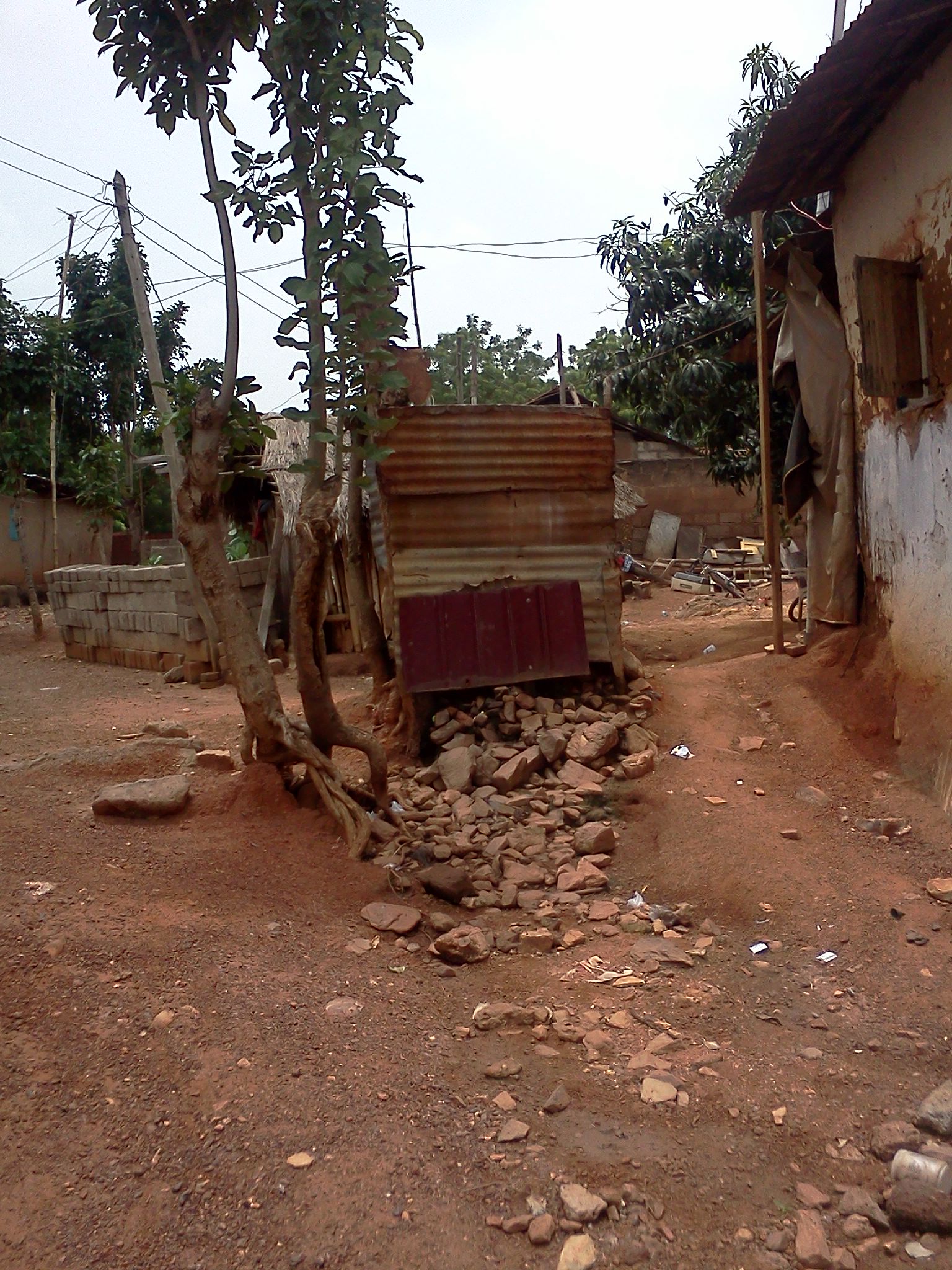
Back view of a “toilet” at a village home in Dodowa. The owner was kind enough to let me use it.
Private bathroom in my bedroom in West Legon.
There IS running water and electricity in parts of Ghana. Not all places have running water or electricity, but many of them do. Unfortunately there is an issue with frequent electricity outages. The people are accustomed to it, and even have a name for it: Doomsor. Some days I had electricity, but almost every day I did not have electricity for 6, 12, or more hours. I seldom had hot water, but it was bearable because the weather is very hot and humid.
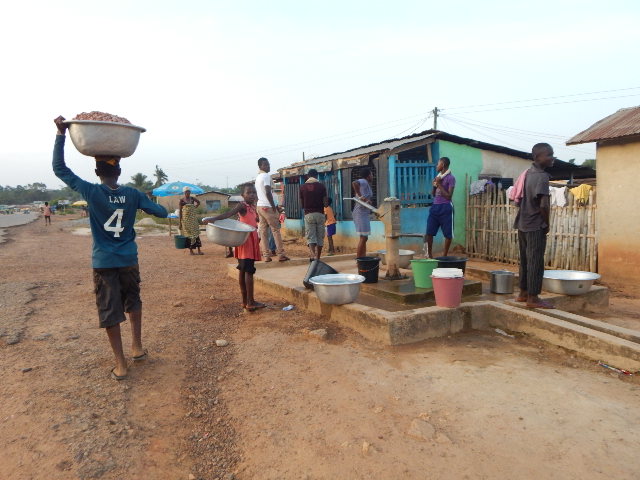
Village children pumping water while a man walks by carrying goods on his head.
Stereotype: There is dangerous “Wildlife” (lions) roaming everywhere.
There are several animals in Ghana. I did not get to see the monkeys, elephants, zebras, and giraffes, but I learned that they have nature reserve parks in different regions where I can go see them. Everyday I did encounter many cows, goats, chickens, dogs, cats, and sheep freely roaming around the streets and in harmony with each other.
Baby goat in Dodowa casually heading under the vehicle for shade.
Herd of cows calmly crossing the street in the city.
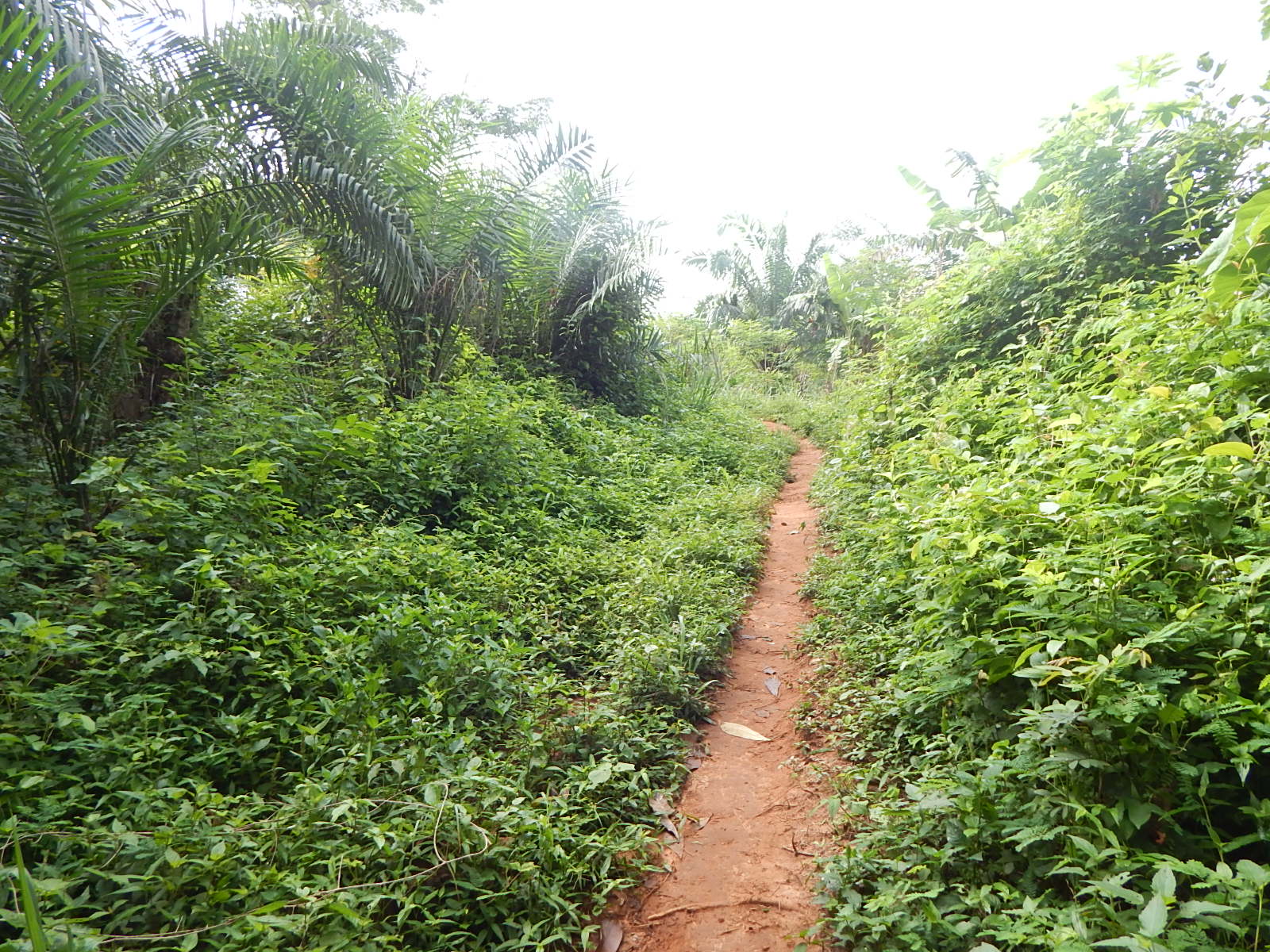
Myth: All of Africa is only Deserts. There is no Vegetation. Ghana is beautiful! I was able to experience the lush Aburi Botanical Gardens, go to the beach, see mountains, and visit the bush areas. Plus, almost every where that I went, there was mango, papaya, avocado, and plenty of foods growing naturally.It was magnificent!
Home on a hill in Aburi
Walking a path out in the “bush” north of Aburi.
Cape Coast (The other side of the Atlantic Ocean)
Stereotype: There is nothing for Tourists because the countries are underdeveloped.
I would recommend that anyone with a genuine interest in the continent of Africa visit at least one country, even if it is only for tourism. In Ghana, there are hotels, spas, shopping malls, museums, national parks, and movie theaters. I am certain that other countries in Africa have the same amenities as well. 🙂
Spa in Sogakope, Ghana (Volta Region)
Museum in Kumasi (Ashanti Region)
Myth: They do not like African Americans.
My experience was that many of the people do like African Americans…and people in general. I was often referred to as “sister” (or “girlfriend” or “wife” by some guys who were really trying to push the envelope). The mindset of the Ghanaian people that I interacted with is , “We are family”. The people were extremely nice, helpful, and I felt very safe. I met some kindhearted individuals and made wonderful new friends during my time in Ghana.
My message to you is this: Africa is a rich and enchanted continent.
Do not allow stereotypes, myths, and targeted media coverage prevent you from visiting Africa, meeting the beautiful people, or exploring other regions of this planet.
If the inner guidance of your heart is pulling you to venture out, give it a try.
A loving presence is understood across all cultures and languages.
It is spring time in the United States of America. The weather is warming, plants are sprouting, and birds are singing in gratitude. Farmers change their crops, and gardeners get to witness the new blooms growing into flowers. Spring is here and announces itself boldly.
It is a beautiful time of rebirth and newness.
A lot of people are aware of this shift and use the spring time as a time for purging the old and making way for the new through “spring cleaning”.
This truly is a great season to explore what is being born in your life.
Think about who you were a year ago today. Are you exactly same? Where were you? Who was with you? How did you view the world? What changed you the most this past year/past season?
One of the best things we can do for ourselves is take the time to be with ourselves. We must nurture our minds, bodies, and spirits and take the time to cultivate our highest qualities, so that we live well-balanced and fulfilling lives.
Based on my current perspective and how I live my life now, I can see that I am dramatically different than I was a year ago. Just a short year ago, I was a little closed off to forming more meaningful, conscious/intentional connections with others. My heart wasn’t as open, and I definitely had an energetic wall up telling the majority of new people: “I like you, but I am not interested in anything more than hello and goodbye.”
At the time I didn’t know that I was so closed. It may have been burnout from another job and the loss of relationships, mixed in with starting new jobs while also trying to build my business. Whatever the case…I was not living as joyfully and freely as I do now.
What changed this?
I changed gradually. I went out to coffee shops and restaurants (usually by myself) with a goal to do some writing while enjoying live music and poetry in the background. That was it. I needed a change of scenery.
However, every time I went out, I felt a tug in my soul and a warm sensation of intense awareness. The tugging helped me to get out of my head. The warm, intense awareness was like an invisible lasso drawing people towards me. I kept meeting people, and it felt different. People were open, smiling, and genuinely curious. It was easy to talk back, smile, and develop connections. Over a short period of time, I had transformed my social life completely. It was unexpected!
The thing is…several months prior to venturing out…I had a longing to connect with more like-minded individuals. I acknowledged the desire by daily affirming, “I love everyone”while tapping into a strong, warm feeling. At some point, I stopped doing this process and released any attachment to how the people I desired were going to appear. I actually forgot about it.
I really didn’t know the depth of the seed that I was planting. When it was time for the seed to sprout, I still didn’t know that it was time. I simply followed my inner guidance to get out of the house to do my writing.
It always amuses me to see how things spring forth in our lives when we stop trying to watch them grow.
Whatever seeds we plant in our Garden of Life will bloom.
When you come into contact or cross paths with another human being that you do not know, what is the primary thing that you want to do?
Do you make eye contact, smile and nod? Do you say Hello? Or, do you work hard to avoid eye contact, keep your space, and keep moving along your way?
What thoughts/feelings contribute to the ways you interact with others?
There is an inner knowing within all of us that helps us to gauge the general vibe of others. Sometimes we can become so distracted with cell phones, music, social media, and other devices, that we don’t tap into our inner guidance system. We might miss out on an opportunity to make a new friend, save a life, or lift up our own moods.
What would happen if you went throughout your day today with the intention that“No ONE is a stranger”? I am not saying that you should run off with a stranger and jump into a dark van with shaded windows. (Please don’t.)
I am referring to the conscious effort to mindfully acknowledge the people that are with you from moment to moment throughout your day.
From a Spiritual point of view,there is no unfamiliar face in our world. We came from the Formless (Spirit/God/Energy/Universe) and were made into Form (Human Beings).
If all of us truly are made from ONE Source, then we really are not strangers to each other.
We simply need to re-introduce ourselves.
Imagine how rich your world will be once you perceive yourself with connections everywhere that you go.
Turn off the music for a moment and say hello.
Look away from your smartphone or tablet, and actually make eye contact.
Love is more than just a feeling. Love Is a way of Living.
Modern culture frequently displays love as a sense of feel-good, fantasy, and endless romantic awe. Yet, these types of examples are temporary expressions of a bigger, more infinite concept. Think about this:When did you first learn about love? Who told you what it means? What thoughts, feelings, and experiences do you associate with love?
Many years ago, I had the misconception that love = suffering. I thought that loving someone always meant to sacrifice, to put the other first, and to stretch myself in order to make the other person happy. I did this not only in romantic relationships, but also in relationships that I considered to be very important to me.
However, one common and major thing kept happening…I was left feeling betrayed, used, and alone.
This sent me on a journey to re-evaluate my understanding of love. I reflected upon my experiences, looked at the spiritual aspect, read books, and then went out and asked questions from my elders.
One of my favorite graduate professors was in his late 80s. He shared this definition of love: “To take delight in the spiritual development of another”. When I first heard it, I felt a squiggly warmth and childlike curiosity. The definition seemed so plain, but when you look at it more closely, it actually involves several layers.
To take delight in another person’s spiritual development also includes the ability to let go of expectation, to eliminate judgment, and to release the need to be right. This way of loving causes you to accept a person as he or she is, because you are aware that spiritual growth is always taking place. To love in this way is to understand that the person is doing the best that he or she can, based upon his or her own circumstances (thoughts, beliefs, actions, feelings)…even if you don’t like it.
Don’t get me wrong. If someone is treating you in a way that is condescending, harmful, or life-threatening, and using “love” as the reason, I am not referring to this situation. This is not love. This is manipulation and abuse.
The love that I am referring to is made up of thoughtfulness, positive regard, and a healthy detachment. Yes, detachment. I’m sure you’ve heard someone say, “If you love someone, you will let ‘em go.”
Loving someone on the spirit level creates a greater sense of freedom for you and that person.
In various Biblical and spiritual texts, it is expressed that “God is Love” (Feel free to put The Universe, Creator, Allah, etc)…and “This Love is unconditional.”
Other texts also express that “Love casts out all fear.” Most of us have attached ourselves to others in unhealthy ways, saying it is love, when it is actually fear. Let go of the fear.
Look and see that the person is on his or her spiritual journey, and smile. Your supportive presence (even if at a distance) is more valuable than hovering around negatively out of your own worry.
Most importantly, see yourself this way. Be there for yourself as you go through your spiritual development. Remember, Real Love is unconditional anyway.
Take delight in your own journey as you Evolve in Love.
“You are the average of the five people you spend the most time with.” –Jim Rohn
“You are the company you keep.”
Heard that before?
Think about it for a moment, and make an observation right now: Who is around you? Who are the people that are a part of your inner circle? What are you listening to right now? What books are you reading? Whose Facebook status are you always checking?
As my life has continued to evolve, so have the people who are in it. Some friendships have faded away, some have emerged, and others have transformed and strengthened over time.
When I was in high school I did not pay close attention to the people who surrounded me. I had friends that were in gangs, had failed classes, and got into fights often. At the same time, I had friends that were part of leadership organizations, in the band, athletic, and some who were academically inclined. I felt like I was connected to all of them, but I didn’t really know who I was.
My lack of self-awareness caused me to get into trouble. I was among the “wrong crowd” and had to deal with being in the wrong places at the wrong times. It was embarrassing and also very confusing.
During my sophomore year, I was selected to become Drum Major in the marching band. Taking on this role shifted my perspective. I had to spend a lot of time with other leaders and forward-thinking people in order to be a leader myself. I started to see some of the foolish things I was doing. I also began to isolate more and look within. Many of my friendships changed, but I knew it was for the better.
In my first year of college, I was somewhat rebellious. I had come from a small hometown where I was not allowed to go out much with friends. When I got out on my own, I wanted to explore the world (or at least Savannah, Georgia). My friends were partiers! We stayed up late, danced, played games, and always found something to laugh about. I loved the times I spent with them!
I made many mistakes, though. I was not seeking answers to important questions because I did not know what I needed to ask. I remember taking a psychology exam and asking my professor how I did on the test. He said to me, “Oh, you probably did how you thought. You made a B.”
But I didn’t think that I made a B. It dawned on me that something about the way I presented myself made me seem like a B was my goal. I was just doing enough to get by, and wasn’t applying any more effort than that, but I did not realize it.
I slowly began to notice that my core values were different than my buddies who I hung out with all the time. I had a scholarship and grant money that paid for my education, and had to maintain certain grades to keep them. Most of my friends weren’t as concerned about their grades, if at all. I also was one of the few people who liked having morning classes, but staying up late made it difficult to get up on time. I surrendered to the fact that I needed some guidance, and had to change the people I surrounded myself with in order to expand the way I was viewing my experience.
I felt drawn to some of the mentors at the university, and I began taking on student leadership roles. I spent a great amount of time serving others and left a legacy on campus. I loved doing that type of service, and I began making more connections to people and situations that lined up with my desires.
Now, I am surrounded by a completely different group of friends. We are conscious, mindful, life-loving, and progressive entrepreneurs. When I look at them, I am inspired to keep expressing my gifts and expanding my personal vision.
The music I listen to on a consistent basis, the movies I watch, and the books I read are all different now as well. They are positive and encouraging. I naturally migrate towards things and people that support my growth and propel me towards continuing to live my passion and purpose.
It is clear that we are all highly impacted by those who surround us. There is a subtle exchange of energy and conscious information that occurs when we spend time, communicate, and connect with others. This same exchange occurs when we listen to music, watch videos/television, and read information.
Maybe it is time for you to reconsider those whom you choose to surround yourself with. Do you feel that these influences are guiding you forward, holding you still, or pulling you back? If you do not like the answer, you have the power to change all of this today. Decide on what you truly desire, and make room for the Divine connections and influences that are sent your way.
Remember: The energy that surrounds us is the energy that we embody.
We have the power to choose how we color our lives.
Think about this: What would happen if another person really knew you and was aware of all your “faults”?
Would you fear that this person would take advantage of you? Would you worry that the person may embarrass you? Would you be concerned that this person may have some type of power over you?
Due to all of these fears, would you start to lie in order to feel as if you have the “upper hand”?
Those are a lot of questions to consider.
Now, think carefully about this next question: What would really happen if this person… wholeheartedly accepted you as you are?
As humans, we often lose transparency due to distraction from our egos. You probably have heard of the term “ego” in psychology, developmental courses, or some forms of spirituality. In metaphysics, our egos can briefly be defined as the part of our humanness that correlates with fear, survival, selfishness, judgment, comparison, competition, and separateness.
Ego is not necessarily a negative part of our human experience; however the nature of it can contribute to internal and external conflicts as a person evolves spiritually.
The further along I have traveled on my spiritual journey, the more easily I notice when my ego appears. For example, I used to be an extreme perfectionist (possibly with traces of OCD) who felt that all areas of my life had to be a certain way. Perfectionism has its place, but it is a problem when it causes high levels of distress. I used to have very high expectations of myself and others, which only led to judgment and self-criticism. At times, I even hid information about myself because I was worried that I would appear “imperfect”. After a while, hiding things while also being judgmental took up a lot of energy and mental attention. It became an act of sorts.
One day, I got into an intense argument with a long-term friend of 10 years. She told me very pertinent things about myself that were difficult for me to listen to because they were so truthful and challenged the perfect image that I had portrayed for so long.
I noticed how far removed I had become from the core of who I am. It stung really bad. Even in that moment, I went through some judgmental thoughts and feelings, but then I released them. It was humbling in the least.
I came to an understanding that I did not have to hide anymore. I did not have to pretend that everything was perfectly aligned exactly how I wanted them to be. I let it all go, and admitted that I had many flaws and was finding my way through them all.
Admitting this about myself was freeing! It changed my perspective, and gave me the opportunity to shift my focus onto things that had more depth and meaning in my life. It truly was refreshing and life-changing.
The next few weeks of the holiday season can be challenging for many people as they spend time with relatives, friends, colleagues, or alone. This is the time of year where stress levels are heightened, loneliness is common, and depression and incidents of suicide increase drastically. This does not have to be. Much of the distress and negative emotions around the holidays come from a belief that things “should be” a certain away. Imagine if every person chose to be transparent, removing his or her veils and masks. So much unnecessary pressure would be lifted. Maybe you are the person to start this transparency trend among those you encounter.
Let it all go. Kindly Be who you are.
The more open we are about who we are and how we feel assists us to create an atmosphere where we are accepted, AND where others are able to be who they are as well.
BE transparent.
It gives us all permission to blossom, expand, and share our inner beauty.
I have done a number of workshops on forgiveness. I came up with these workshop ideas because I noticed that across the board, many of my clients had underlying resentments. These issues were preventing them from receiving what they really desired. I chose to do these workshops also because I did some extensive forgiveness work with my father. I experienced some amazing and mind-blowing results. (I will share the story with you about my father in a later post.) In this post, I am addressing forgiveness because once again I was put in the place of doing so.
Many people will admit that it can be hard to forgive a former romantic partner. I definitely can.
I was in a long-term relationship with someone who, in the end, realized that he did not want the relationship, noting that he was not ready for it. I became upset with him because I felt that he should have known this before we had been together for as long as we had been. I also was upset because, based on some of his behaviors, he seemed like he already knew that he didn’t want the relationship well before he spoke up about it. When he ended the relationship, he expressed to me that we should be friends, but I was just not ready to hear those words. This was disappointing to hear because I was expecting more to develop in the relationship itself at that time.
We had a set of mutual friends who had a habit of asking me where he was whenever they saw me. I became angry, defensive, and would fight back glaring looks as I haughtily remarked, “You know we’re not together right?” They would look at me and gently say, “But you two are friends.” I thought they were insane. This type of pattern went on for several months. I grew angrier because he seemed to be nowhere around to deal with the mess he had made.
One day I decided to seek a neutral spiritualist perspective, so I spoke with a Tarot reader about the situation. She looked at the cards and said, “You’re holding a grudge against him. You two can’t be friends if you are holding a grudge.” I was a little surprised that she said that to me (being that I am a Healer and could heal myself and others), but I knew it was true. The surprise was moreso that the grudge itself was upset because it could no longer hide in the shadows of my subconscious. I reflected on her words and the nature of the grudge.
Every time that I looked at him post-breakup, I viewed him with eyes of criticism, judgment, anger, and hurt; looking for all his faults. Before the breakup, I saw him with more clarity. I saw his spirit, appreciated his compassion, his kindness, enjoyed his talents, and admired his quest to bless many by shining his own Light. That is what I loved about him. It was not his behaviors that I loved, but him as he is. It was time to let go.
Thus, I had to begin the journey of forgiveness again. I thought to myself, “If I can forgive my dad for the abuse growing up and for not being there for me the way that I needed him to be, then I can truly forgive a guy that I have only known for a few years.” Yet I struggled. I felt as if I didn’t have to forgive him because he was the one that did something wrong. In reality, we both played a part in what happened between us. (More on that later in this post.)
What does it take to forgive? One of the most important things is the willingness to do so. Before I could get to the place of saying that I forgive him for his behaviors, I had to at least say, “I am willing to forgive you for them.”
From the willingness, grew the readiness to forgive. Once I was ready to forgive, I was able to look at the entire situation from the lenses of Love. This was not human, conditional love, but unconditional Divine Love.
I sat down, took out a sheet of paper, and wrote out all of the wrongs that I felt happened in the relationship. I wrote them vigorously with serious intention to let go. I then took out another sheet of paper and wrote out all of the things that I loved about him. Holding that loving feeling in my conscious awareness, I went back to the list of wrongs. I drew a line under them, and wrote the sentence, ‘I forgive you for…’ as I went through each item. I tore that paper up, saying out loud, “I set myself free.”
I looked back at the list of things that I loved about him. When I looked at those things again, I saw that they weren’t conditional at all; they were the Essence of who He Is. I chose to appreciate his presence in my life, even though it wasn’t in the way that I desired. He played a role that sparked me to grow as a person.
Then, a deeper knowing struck me–I needed to forgive myself for allowing things to continue in a way that I did not desire or deserve. I needed to forgive myself because I love me as well. I did the same ritual that I did for him, but for myself this time. It was insightful, yet freeing. All of those things that happened between us began to seem so small. I knew that none of it really mattered. I could see that Ultimate Love remained present through it all.
This is what I hope you take away from reading this post: Although forgiveness may be challenging at times, it is extremely powerful when done from a place of Love. Forgiveness empowers you, sets you free, and releases the old energy tied into something that really has no power in your present life. It opens up the doorway to live more beautiful and desirable lives.
Now that I have chosen to forgive, I am ecstatic to see the beauty that is allowed to grow because of the loving space that I have created. You may do the same for yourself as well.
And so it is.
























 .
. Metaphysical Freedom