I believe that these three words can have more weight than “I love you”. For instance, I love people in general and I love my cat. Based on a previous definition I gave of love (Love…Anyone?), it is impersonal but also delightful.
Trust, on the other hand, is very personal. Merriam-Webster’s Dictionary defines trust as “assured reliance on the character, ability, strength, or truth of someone or something.” Sounds quite personal to me. Trust can be developed, or it can already be established, depending on the situation.
Either way, it can be lost.
Someone can love another person but feel he or she cannot trust that person. Trust is a delicate gift that requires vulnerability.
In my profession of healing and transformation, the people I serve must trust me. They trust me to keep their best interests in mind. They trust me to be knowledgeable and experienced in the services I provide. They trust me to honor their sacredness and respect their privacy. Most of my clients do not say the three words out loud, but their actions and willingness in the sessions speak to this truth.
Ultimately, when you trust someone, you are allowing yourself to be in the vulnerable space of innocence and complete surrender. One of the most detrimental things that can happen in this line of work is for the healer to violate or break the trust of their client.
I could go further into this issue, but I will focus more on things you can do (as a client) to see if someone is trustworthy. These suggestions are geared towards the healing profession; however they can also be applied to personal interactions as well:
Do your research (Is the person qualified? What do others say about their experiences with the person? What skills/characteristics are you looking for?)
Listen to your gut (Intuition supersedes intellect; Do you feel safe? Do you feel heard? Do you feel respected?)
Ask questions (Get clarification on whatever you need to.)
Express yourself (Make your requests and needs known. Then refer back to number 2.)
In a society that promotes selfishness and self-centered gains, it is important for those of us in the healing profession to be selfless and genuine about providing the service the client needs.
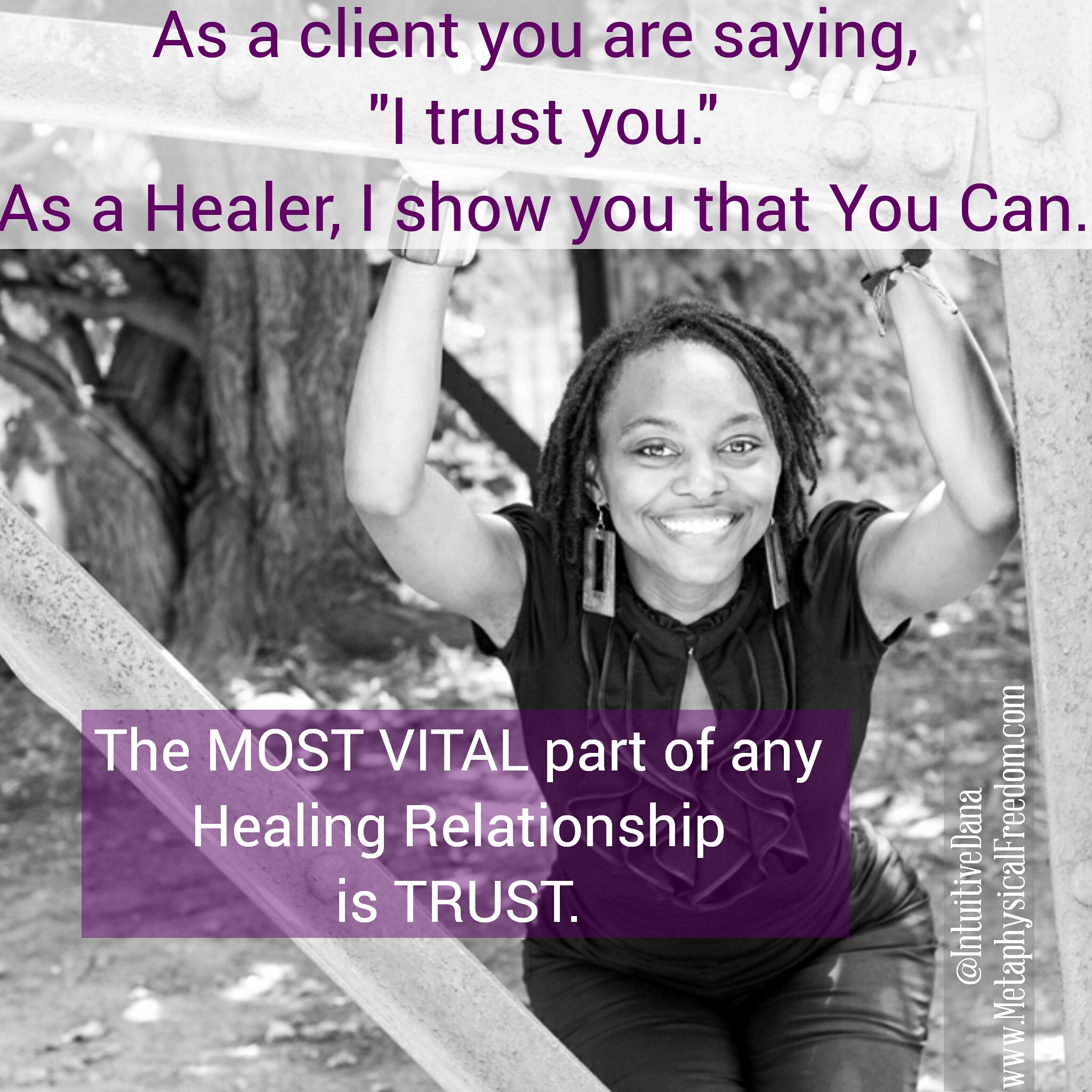
The MOST VITAL part of any healing relationship is TRUST.
“This is your world. Shape it or someone else will.” -Gary Lew
This is one of the reasons why I do what I do.
We live in a world where there are several, easily accessible distractions from Self and the transformative power within.
I took a hiatus from blogging and public speaking to detach and recharge from all the energetic “stuff” that has been happening, to re-mind myself of what is true for me, and to stay grounded in this knowledge by seeing through the distractions.
We can become so accustomed to looking at social media, websites, and the news that these things easily become subconscious influencers.
The next time you scroll or flip the channel, think about what you really believe, what you really desire for yourself (and the world), and if the things you are entertaining and doing match those desires. If not, put down the phone (tablet, remote, etc.), wake up from the distractions, and do something different.
As a psychotherapist, one of the last things that I want to hear is that one of my clients has killed or taken the life of himself or herself (or someone else). It is not because of a personal feeling of failure, but because of a sense that somewhere in the process, my client has lost hope. As therapists, one of our most powerful intentions is to instill hope. It is not a starry wish, but a sense of purpose and encouragement.
When I was in graduate school, I was drawn to the more intense subjects such as traumatology, addiction, and crisis stabilization work. I loved them! I remember sitting in a crisis intervention class and hearing my professor clearly state, “In all your years as a therapist, all of you will lose at least one client to suicide. Be prepared for it. It will happen. Oh, and those of you who are working with trauma and addiction, you can definitely expect it to happen.” He spoke those words with a matter-of-factness that revealed long years of personal experience. I did not want to believe him, but I also knew that there was some underlying realness to what he said.
Even with this warning, I pressed on and continued down the path to become a licensed therapist. I did not and could not lose hope in the long-lasting positive impact of the work we do. I believed that following my passion and helping others to see their inner light was worth much more than living in fear of those who might not see it.
For a little while, I even worked for a crisis hotline. Some of the callers were blatantly at the point where they had chosen to end their lives. I encouraged some to rethink their situations and to see that life might actually be worth living. However for some, I do not know if they did or did not take their lives…the calls simply just ended.
Ironically enough, I didn’t feel disappointment, but gratitude. How might one be grateful for such a thing? I fully understood that the conversations that I had with the callers may have been their last conversations ever. I was at least thankful to talk to them in the present moment and be some type of positive, loving voice before they departed (or decided to live).
And here I am… 8 years and 2 client suicides later.
I will not get into too much detail about the 2 client suicides; however I will say that both were very sobering experiences for me. I re-learned that suicide shows up in many forms.
A spiritual reality about suicide came to me as well:
A person’s exit from this world is not an accident. The way we transition may serve a greater purpose, just like the way we live. It is true that sometimes a person’s life purpose may not be easily understood or clear. But be aware that every life, no matter how short, undoubtedly leaves a precious legacy on this planet.
Every day that I choose to continue working as a psychotherapist and addiction counselor, the possibility of losing a client to suicide, overdose, or something exists. Yet, if a little piece of hope surfaces, then I believe there is a chance that the person will see tomorrow. I Know the power of hope. It starts as a glimmer, and then it becomes a belief. Belief is when the person sees more light and direction. Then a belief transforms into Knowing. Knowing (in this context) is when the person is aware that Life Is.
If you or someone you love is struggling with depression, suicidal thoughts, or self-harm, please Know that There is Hope.
For nationwide support in the United States you can contact: 9-8-8.
When your heart speaks to you, do you listen? OR Do you talk yourself out of what is being said to you?
There comes a moment when we know without a doubt that we are being called to do more with our talents, our gifts, and essentially our lives.
Depending on where you are in your journey, some people might call it a mid-life crisis. In some spiritual communities, this process is referred to as Divine Discontent. I like to use this phrase because it is more than just a developmental stage; it is the Universe’s way of getting your attention and growing you into someone even better than you were before.
From personal experiences, and working extensively with several clients, I recognized that this process typically happens in stages.
Here is my summary of the stages related to Divine Discontent:
Stage 1: Misalignment= This is when you begin to feel out of sync with what is going on in your life. The things that you normally do might start to feel monotonous and boring. You might start to feel fleeting senses of disinterest or displeasure for these things. (Not to be mistaken for depression symptoms.)
Stage 2: Denial=The awareness of your misalignment increases, but instead of looking further into the reason behind it, you go against what you are feeling and try to continue in your monotony. You basically talk yourself out of whatever it is that you are feeling…or at least you try… which leads to the next stage.
Stage 3: Detachment = This is when you still are not quite ready to “dig deep” and give anything up or make major changes, so you start to distance yourself emotionally from the things that are causing the discontent. Unfortunately, this state of discontent may also spill over into other things in your life. People might notice and comment on your shift in mood and your distant presence. You can’t hide it anymore.
Stage 4: Epiphany/Climax/Aha Moment =This is when Shift Happens. Your discontent pushes you to the edge of introspection. You look inward, and question what is at the core of your feelings. You realize that you need to make changes, whether small, medium, or major ones. You decide that you are willing to make these changes.
Stage 5: Pursuit = You take action and make the necessary changes so that your discontent decreases. You actively seek guidance, whether it be inward, from mentors, or both. You change your direction and move towards your new goal.
Stage 6: Alignment= You feel more alive and the things you are doing or engaging in feel right. You no longer have that unpleasant sense of monotony or boredom. You are in motion, and it seems like everything and everyone around you are propelling you so that you stay in motion.
Stage 7: Realization= You reach that point of bliss where you know that you are doing what you are meant to do. You have moments where you reflect upon where you were before this stage, and you are grateful that you made the changes. You realize that everything was already worked out for your benefit, and all you had to do was take the first step.
Consider what things (or people) in your life that you feel discontent with. How long have you allowed this feeling to linger?
I am currently in Ghana, in the western part of Africa, on my first trip to the continent. I arrived in the city of Accra late on a Tuesday night in March. I was nervous, excited, and exhausted all in one. The customs line for foreigners was very long, so it took over an hour for me to get through. When I made it outside the airport, the first thing that I felt was extreme heat and humidity. I had been on the freezing cold airplane for several hours, the airports were very cold, and then suddenly it was hot. The second thing I noticed was all the Black people…Africans. They looked so beautiful, glowing, and so dark that their skin mixed with the night sky. It was lovely.
My first week here was spent doing tourist-like activities. I have been exploring the region and getting a better understanding of the people. During this tour, I visited Cape Coast Castle and the El Mina Castle. Some ex-pats refer to these locations as the Dungeons instead of castles. These are places where Africans were held in captivity before boarding ships to be sent to other parts of the world as slaves.
Needless to say, going on a tour of the castles was an emotional experience for me. Maybe not in the way that you would think, though. Instead of tears of sadness and sorrow, I became very angry when I heard about the inhumane things that were done to my ancestors. Although I learned about slavery, I was only given a small perspective—one from the lens of American History. The more I learned, the angrier I became. It was disturbing to think about the level of maltreatment that one human can inflict upon another and continue to live a fairly normal day-to-day life.
I heard about the ways that Africans assisted the Europeans to capture other Africans, especially if they were from another tribe or were offered a large amount of European goods.
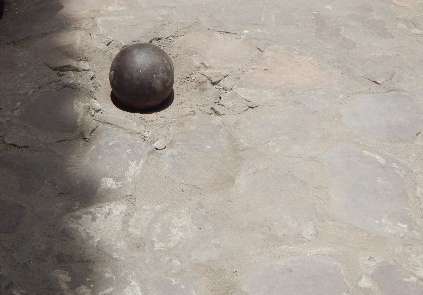
I learned how the female slaves in the castle were abused and sexually exploited by the governor and his men. The women were forced out of their dungeon and had to walk in a small open courtyard. The governor’s quarters overlooked the courtyard. He simply would point at the woman he wanted to have sex with, and then she was taken through a secret door to his bedroom. Once he was done, she was put back in the dungeon with the others. If she refused, she was left outside, a ball and chain around her ankles to suffer…as punishment.
In the courtyard: Ball (without chain) for female slaves who refused sex
There is a great amount that I would like to write about this experience, yet I will keep this post brief. (Maybe this will turn into a book.) One other thing that I will mention is the “Door of No Return”. The slaves were kept in the dungeons for weeks and months at a time (men and women were separate). Think about it: Hundreds of people in one room–eating, sleeping, defecating, urinating, sick, etc…in ONE small room. The ones who died were taken out and tossed into the sea. The ones who survived made the life-altering journey onto the ships that transported them all over the world…. when they walked through the Door of No Return. Not only did they have to endure the dungeons, but the ones who survived had to endure the ship rides around the globe. What a shame that so many people suffered from this tragedy at the hands of their own people.
This is only a miniscule piece of the history of this planet.
Door of No Return
Why am I writing any of this? Because I desire for you to open your eyes and your mind.
Slavery still exists today, right here and now, and it takes on many forms. Some examples are: Mental slavery, economic dis-empowerment, sex trafficking, free/cheap labor, and cultural imperialism.
I refuse to believe that human nature is naturally selfish, greedy, and immoral.
Yet, I do wonder: What will it take for all humans to see each other as fellow brothers and sisters on this planet? How can we mend the mistakes of those before us and live in a peaceful world instead of repeating this revolving pattern?
Several RIP flowers and gifts were left in the dungeons from visitors around the globe.
In spite of the anger I felt, I found one thing to be slightly comforting. Several people from all over the world left gifts, flowers, and memorials for the slaves who were in the dungeon. Most of them read, “Rest In Peace” and referred to humanity learning a vital lesson from the pains of the slave trade.
I know that healing is possible. But first, we must have compassion for ourselves and each other.
Love is more than just a feeling. Love Is a way of Living.
Modern culture frequently displays love as a sense of feel-good, fantasy, and endless romantic awe. Yet, these types of examples are temporary expressions of a bigger, more infinite concept. Think about this:When did you first learn about love? Who told you what it means? What thoughts, feelings, and experiences do you associate with love?
Many years ago, I had the misconception that love = suffering. I thought that loving someone always meant to sacrifice, to put the other first, and to stretch myself in order to make the other person happy. I did this not only in romantic relationships, but also in relationships that I considered to be very important to me.
However, one common and major thing kept happening…I was left feeling betrayed, used, and alone.
This sent me on a journey to re-evaluate my understanding of love. I reflected upon my experiences, looked at the spiritual aspect, read books, and then went out and asked questions from my elders.
One of my favorite graduate professors was in his late 80s. He shared this definition of love: “To take delight in the spiritual development of another”. When I first heard it, I felt a squiggly warmth and childlike curiosity. The definition seemed so plain, but when you look at it more closely, it actually involves several layers.
To take delight in another person’s spiritual development also includes the ability to let go of expectation, to eliminate judgment, and to release the need to be right. This way of loving causes you to accept a person as he or she is, because you are aware that spiritual growth is always taking place. To love in this way is to understand that the person is doing the best that he or she can, based upon his or her own circumstances (thoughts, beliefs, actions, feelings)…even if you don’t like it.
Don’t get me wrong. If someone is treating you in a way that is condescending, harmful, or life-threatening, and using “love” as the reason, I am not referring to this situation. This is not love. This is manipulation and abuse.
The love that I am referring to is made up of thoughtfulness, positive regard, and a healthy detachment. Yes, detachment. I’m sure you’ve heard someone say, “If you love someone, you will let ‘em go.”
Loving someone on the spirit level creates a greater sense of freedom for you and that person.
In various Biblical and spiritual texts, it is expressed that “God is Love” (Feel free to put The Universe, Creator, Allah, etc)…and “This Love is unconditional.”
Other texts also express that “Love casts out all fear.” Most of us have attached ourselves to others in unhealthy ways, saying it is love, when it is actually fear. Let go of the fear.
Look and see that the person is on his or her spiritual journey, and smile. Your supportive presence (even if at a distance) is more valuable than hovering around negatively out of your own worry.
Most importantly, see yourself this way. Be there for yourself as you go through your spiritual development. Remember, Real Love is unconditional anyway.
Take delight in your own journey as you Evolve in Love.
Think about this: What would happen if another person really knew you and was aware of all your “faults”?
Would you fear that this person would take advantage of you? Would you worry that the person may embarrass you? Would you be concerned that this person may have some type of power over you?
Due to all of these fears, would you start to lie in order to feel as if you have the “upper hand”?
Those are a lot of questions to consider.
Now, think carefully about this next question: What would really happen if this person… wholeheartedly accepted you as you are?
As humans, we often lose transparency due to distraction from our egos. You probably have heard of the term “ego” in psychology, developmental courses, or some forms of spirituality. In metaphysics, our egos can briefly be defined as the part of our humanness that correlates with fear, survival, selfishness, judgment, comparison, competition, and separateness.
Ego is not necessarily a negative part of our human experience; however the nature of it can contribute to internal and external conflicts as a person evolves spiritually.
The further along I have traveled on my spiritual journey, the more easily I notice when my ego appears. For example, I used to be an extreme perfectionist (possibly with traces of OCD) who felt that all areas of my life had to be a certain way. Perfectionism has its place, but it is a problem when it causes high levels of distress. I used to have very high expectations of myself and others, which only led to judgment and self-criticism. At times, I even hid information about myself because I was worried that I would appear “imperfect”. After a while, hiding things while also being judgmental took up a lot of energy and mental attention. It became an act of sorts.
One day, I got into an intense argument with a long-term friend of 10 years. She told me very pertinent things about myself that were difficult for me to listen to because they were so truthful and challenged the perfect image that I had portrayed for so long.
I noticed how far removed I had become from the core of who I am. It stung really bad. Even in that moment, I went through some judgmental thoughts and feelings, but then I released them. It was humbling in the least.
I came to an understanding that I did not have to hide anymore. I did not have to pretend that everything was perfectly aligned exactly how I wanted them to be. I let it all go, and admitted that I had many flaws and was finding my way through them all.
Admitting this about myself was freeing! It changed my perspective, and gave me the opportunity to shift my focus onto things that had more depth and meaning in my life. It truly was refreshing and life-changing.
The next few weeks of the holiday season can be challenging for many people as they spend time with relatives, friends, colleagues, or alone. This is the time of year where stress levels are heightened, loneliness is common, and depression and incidents of suicide increase drastically. This does not have to be. Much of the distress and negative emotions around the holidays come from a belief that things “should be” a certain away. Imagine if every person chose to be transparent, removing his or her veils and masks. So much unnecessary pressure would be lifted. Maybe you are the person to start this transparency trend among those you encounter.
Let it all go. Kindly Be who you are.
The more open we are about who we are and how we feel assists us to create an atmosphere where we are accepted, AND where others are able to be who they are as well.
BE transparent.
It gives us all permission to blossom, expand, and share our inner beauty.
You may have heard numerous times that “gratitude is the best attitude” or some similar type of slogan. The ideology behind these types of quotes implies that staying positive helps one to cope with life’s stress.
From an energetic perspective, everything has a vibration, frequency, and overall feeling. Our thoughts, words, pictures, places, vehicles, jobs, etc. all emanate some form of energy.
We are energy.
Imagine what it would be like if you got up every day and expressed thanks instead of dread.
I have found that the more I give thanks, the more I find things to be grateful for.
Here are a few examples…
When I wake up in the morning, the first thing I usually say out loud (or in my thoughts) is: “God, thank you for this lovely new day.”
When I get up and do my morning routine (shower, eat, wash my face, brush my teeth, etc) I say different types of thanks, but they are usually like this: “I am thankful that I have warm, clean, running water that I can bathe myself with. I am thankful that I have the ability and functionality to take care of my own body. I am thankful that I have food to eat and it is easily accessible. I am thankful for my life, and I know that everything works for my good and in my favor.”
When I am stuck in traffic, I still give thanks and say: “I am thankful that I have a car that is in good condition and takes me to and from where I need to go. I am thankful that I have a job and a way to take care of my needs.”
Even when I have felt “hurt”, upset, and frustrated, I have given thanks saying: “I am thankful that I can experience emotions. I am thankful for my tears. I am grateful that I can allow myself to feel my feelings.”
When there is a death, I still give thanks and say: “Thank you God for allowing this person to be in my life. Thank you for my role in this person’s life. Thank you for the wonderful experience that I had in sharing Life with this Being.
I encourage you to begin this type of dialogue in your daily routine. You can start with small steps. For instance, being out in nature made giving thanks such an easy “task” for me.
Giving thanks shifts our perspectives from lack to abundance. Giving thanks opens the door for more things to be grateful for. Giving thanks is a form of prayer that affirms our victory.
As a psychotherapist, one of the last things that I want to hear is that one of my clients has killed himself or herself (or someone else). It is not because of a personal feeling of failure, but more so because of a sense that somewhere in the process, my client has lost hope. As therapists, one of our most powerful intentions is to at least instill hope. It is not a starry wish, but a sense of purpose and encouragement.
When I was in graduate school, I was drawn to the more intense subjects such as traumatology, addiction, and crisis stabilization work. I loved them! I remember sitting in a crisis intervention class and hearing my professor clearly state, “In all your years as a therapist, all of you will lose at least one client to suicide. Be prepared for it. It will happen. Oh, and those of you who are working with trauma and addiction, you can definitely expect it to happen.” He spoke those words with a matter-of-factness that revealed long years of personal experience. I did not want to believe him, but I also knew that there was some underlying realness to what he said.
Even with this warning, I pressed on and continued down the path to become a licensed therapist. I did not and could not lose hope in the long-lasting positive impact of the work we do. I believed that following my passion and helping others to see their inner light was worth much more than living in fear of those who might not see it.
And here I am… 6 years and 2 client deaths later.
I will not get into too much detail about the 2 client deaths; however I will say that both were due to overdoses. They were very sobering experiences for me. I re-learned that suicide shows up in many forms. It can be a drug overdose, hanging, gunshot wound, stabbing, train, car, traffic, etc.
For a little while, I even worked for a crisis hotline. Some of the callers were blatantly at the point where they had chosen to end their lives. I encouraged some to rethink their situations and to see that life might actually be worth living. However for some, I do not know if they did or did not take their lives…the calls simply just ended.
Ironically enough, I didn’t feel disappointment, but gratitude. How might one be grateful for such a thing? I fully understood that the conversations that I had with the callers may have been their last conversations ever. I was at least thankful to talk to them in the present moment and be some type of positive, loving voice before they departed (or decided to live).
A spiritual reality about suicide came to me as well:
A person’s exit from this world is not an accident. The way we transition may serve a greater purpose, just like the way we live. It is true that sometimes a person’s life purpose may not be easily understood or clear. But be aware that every life, no matter how short, undoubtedly leaves a precious legacy on this planet.
Every day that I choose to continue working as a psychotherapist, the possibility of losing a client to suicide/overdose/something exists. Yet, if a little piece of hope surfaces, then I believe there is a chance that the person will see tomorrow. I Know the power of hope. It starts as a glimmer, and then it becomes a belief. Belief is when the person sees more light and direction. Then a belief transforms into Knowing. Knowing (in this context) is when the person is aware that Life Is.
If you or someone you love is struggling with depression, suicidal thoughts, or self-harm, please Know that There is Hope.
For nationwide support in the United States you can contact: 1-800-273-TALK (8255)
There are times when you want something so eagerly that you become obsessed with seeing it come to fruition. You might even pray and replay this desire over in your mind until it seems to be an automatic thought embedded into your subconscious. You might even begin to feel the ‘If I could just do this, then this will happen’ syndrome forming. But wait.
It is true that visualization, feelingization, visioning, and intentional focus are key elements for bringing your desires forth. However, when these tools go from being exciting and inspiring to routine and monotonous habits, then you have switched gears. It means that you have gone from the openness of allowing into the muddy waters of controlling. And frankly, trying to control just doesn’t work.
When you attempt to control something, it is the perfect formula for progress in the opposite direction of what you desire. Controlling behavior is on a lower level vibration of consciousness; it is based out of fear. Unfortunately, when you focus on your desire from this point of view, you bring the fear into reality.
How can you overcome the desire to control? Remember to seek and allow.
Seeking is the active pursuit to gain knowledge and understanding of something, or to literally search for something. When a person seeks something, he or she does not always know what the exact outcome will be because there is a subtle openness to allow the information to flow in. Allowing is being open and receptive, removing attention away from the desire, and knowing that the desire will occur as it is meant to.
Many people mistake allowing for passivity. It is not passivity. It is the active application of faith. Allowing occurs when we remove the need to control and actually step out on “blind faith”, into the unknown.
I went through my college undergraduate years without having a car. I really wanted a car, but the opportunity for a reliable and inexpensive one didn’t present itself during that time. Right before I graduated college, I began searching and applying for jobs. By the time I graduated, I was jobless, car-less, and had moved back home to live with one of my brothers. I continued with the job search, but also took breaks and focused my energy on other activities. A few months passed. One day I got a call from a director of a program at the university that I graduated from. The director said, “I was told that you are an excellent worker. We need someone to come and work in our department. Can you do a phone interview at the end of next week?” I said yes.
I spent most of that week searching for a new car. I found one that I liked, but the dealer told me that I had to at least show proof of income since I had no type of credit. (I graduated debt free.) I left the dealership with a knowingness that I would get that car. I just knew it was meant for me, but I didn’t know how I would get it. My parents couldn’t afford to buy it at the time, and besides, I wanted to do it on my own.
The night before the interview, I contacted my oldest sister and told her about the job and the car. I asked her to pray with me. I vaguely remember everything that was said in the prayer, but I know that she declared the job and the car were mine. What I remember the most is how I felt during and after the prayer. I was calm, yet excitedly expectant. I just knew that something good was coming.
The interview happened the next day. It was going well and coming to a close when the panel asked me one last question: “Will you have a reliable car to travel in?” Without hesitation I said, “Yes.” They thanked me and told me that they would notify me of their decision.
A few weeks later I found out that I got the job, and they mailed me an offer letter. I took that letter down to the car dealership. I got the new car that I wanted.
Several other events similar to this have occurred in my life and continue to occur. I have become more conscious of my role and I use this awareness to allow more expansive opportunities to come forth. I have learned that part of receiving what I truly desire starts with seeing it, feeling it, knowing it is mine, and letting go of the way it happens.
I leave this message for you:
“Do not look for something that is already yours. Expect it. Do you look for your lungs while you breathe? Do you search for your eyes as you read? No. You know that they are there. Do Not search for what is already yours. Know it is yours and expect it. Do not expect it within a certain time frame, but expect it with certainty. Allow it to be. It Is already yours.”

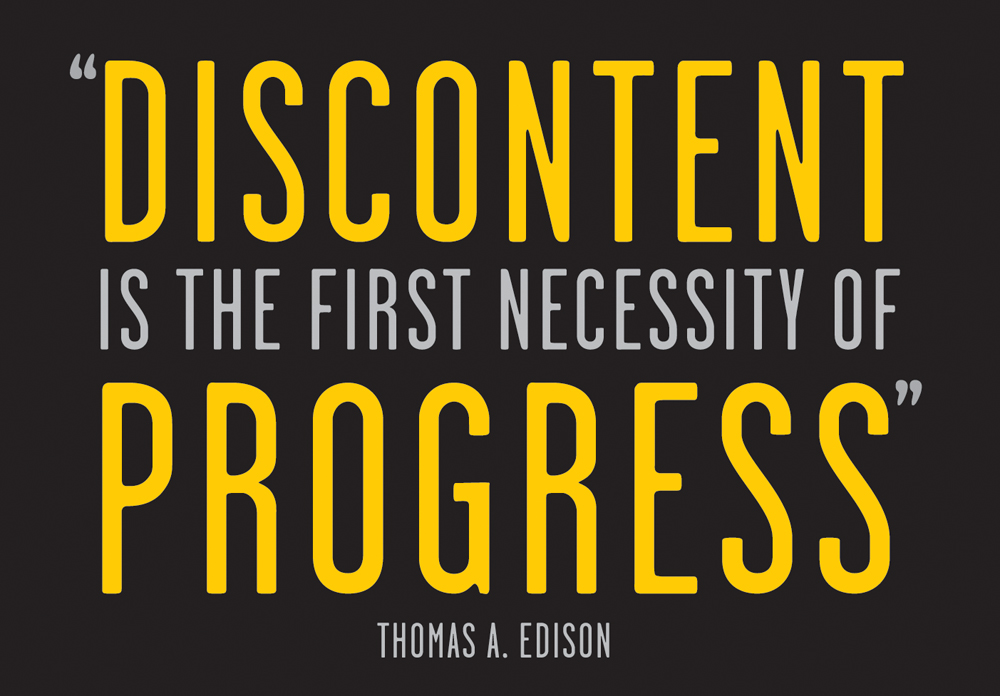
 This quote speaks volumes.







 Metaphysical Freedom